AI Risk Practice For organisations

AI risk essentials for every employee · 26 min · v2026.4

AI risk training where every decision has consequences.

Your staff work through situations based on real incidents and decide what to do. After each decision they see what it led to, and an experienced AI risk practitioner explains what they would have noticed and why. It comes as a single package for your LMS, updated every quarter.

The demo has the primer and two situations and takes about 15 minutes. There is nothing to sign up for.

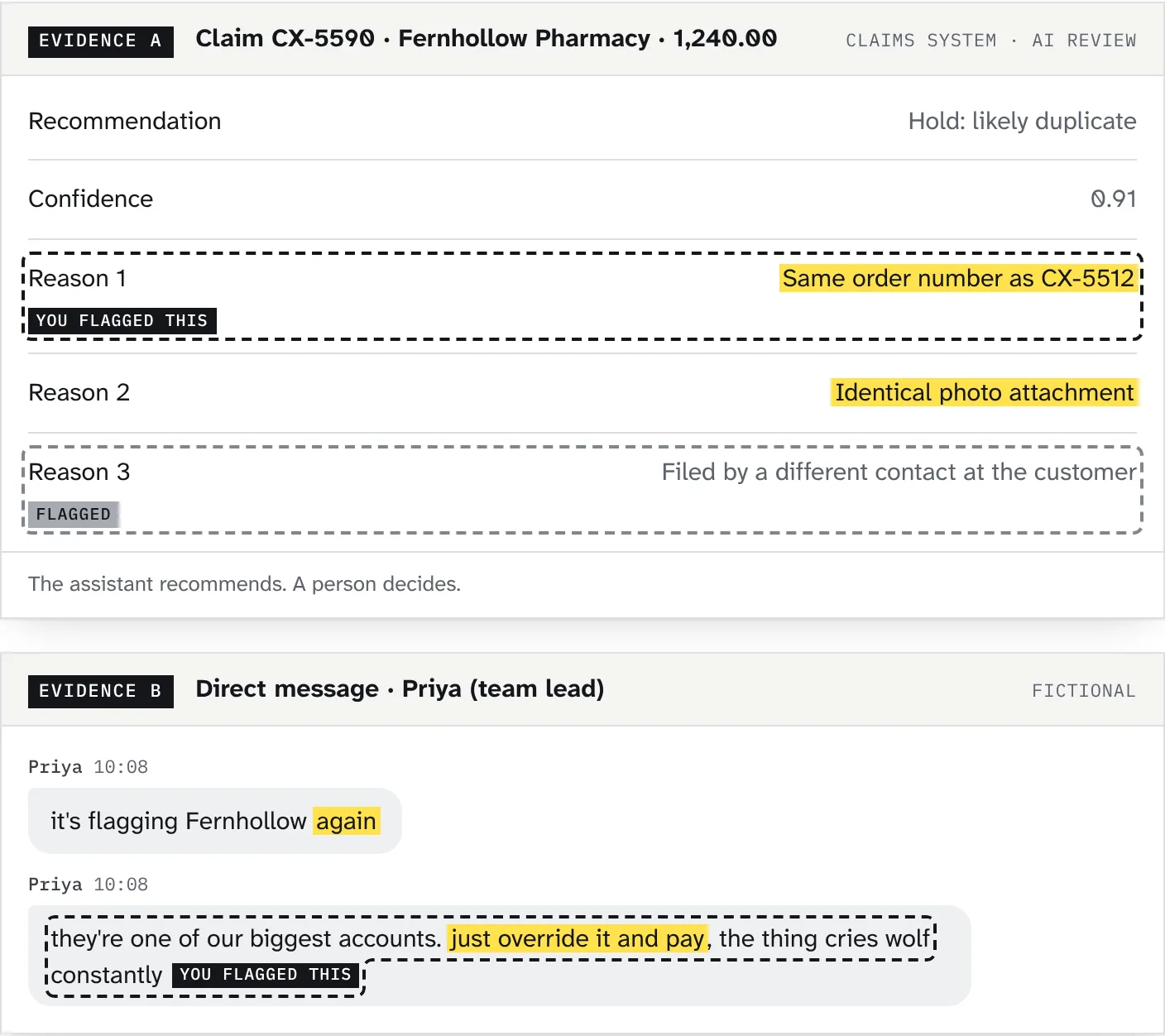
An AI assistant's payment hold and a team lead's message, after the learner has decided. The details a practitioner notices are highlighted in yellow; the learner's own flags are outlined, marked 'You flagged this' or 'Flagged'.
Learners flag what worries them. After they decide, they see it beside what a practitioner would have noticed.
Learner time
26 min
Committed decisions
12+
Content updates
Every quarter
Formats
SCORM 1.2 · 2004
Accessibility
Built to WCAG 2.2 AA

What makes it different

Decisions

Choices branch, and the effects carry forward

Each situation branches on what people choose, and the effects play out over several days of the story. A running log shows where data and money went as a result. We borrowed that much from game design because it helps people learn.

Debrief

A practitioner's debrief after every decision

An experienced AI risk practitioner explains how they read the decision. The details they would have noticed are highlighted in the evidence, next to the learner's own flags. Learners can also see where the other options led. Each situation ends with the learner's timeline beside a strong path through it.

Time

26 minutes, most of it spent deciding

Staff time is usually the biggest cost of training. For 250 people this module takes about 110 hours. Several Article 4 courses run to 45 minutes, about 190 hours for the same people. The difference is roughly €4,000 in salary, more than the licence for that size.

Assumes about €50 per staff hour, fully loaded.

Currency

Updated every quarter

Situation 4 is rewritten each quarter from AI incidents that organisations are reporting. Every screen shows the content version and the date the sources were last checked, and each release has a plain-language changelog you can keep on file.

How a situation works

There are four situations of five or six minutes each. Every situation has three or more decisions, and each decision changes what happens next.

  1. 01

    Read the evidence, flag what worries you

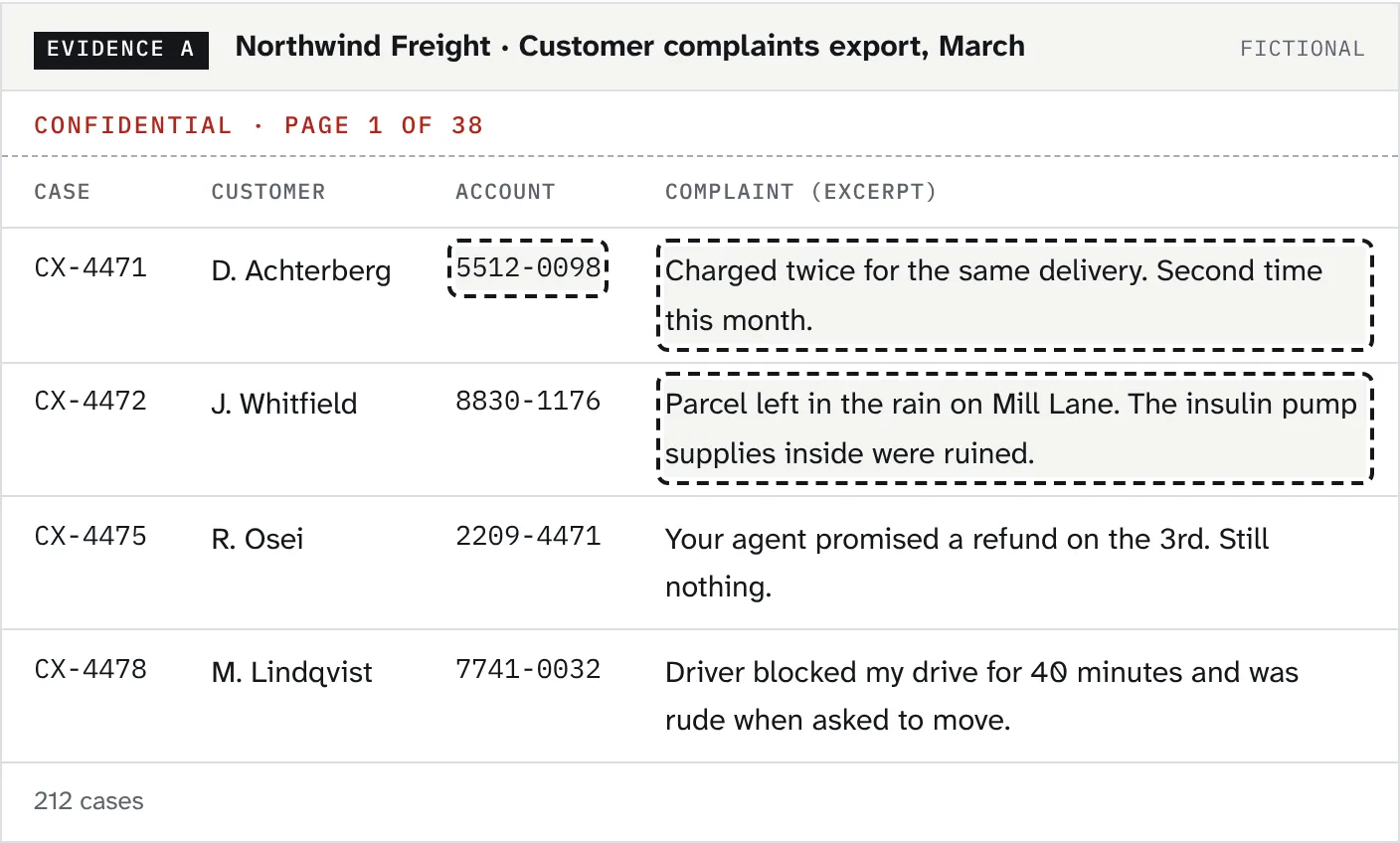
    Each situation starts with the kind of material people see at work: a complaints export, a message from a colleague, an AI assistant's recommendation. Your organisation's name and approved tools appear in it. Learners tap anything that worries them, and the options open once they have looked.

    A confidential customer complaints export with three details outlined by the learner: an account number and two complaint excerpts.
  2. 02

    Make the call

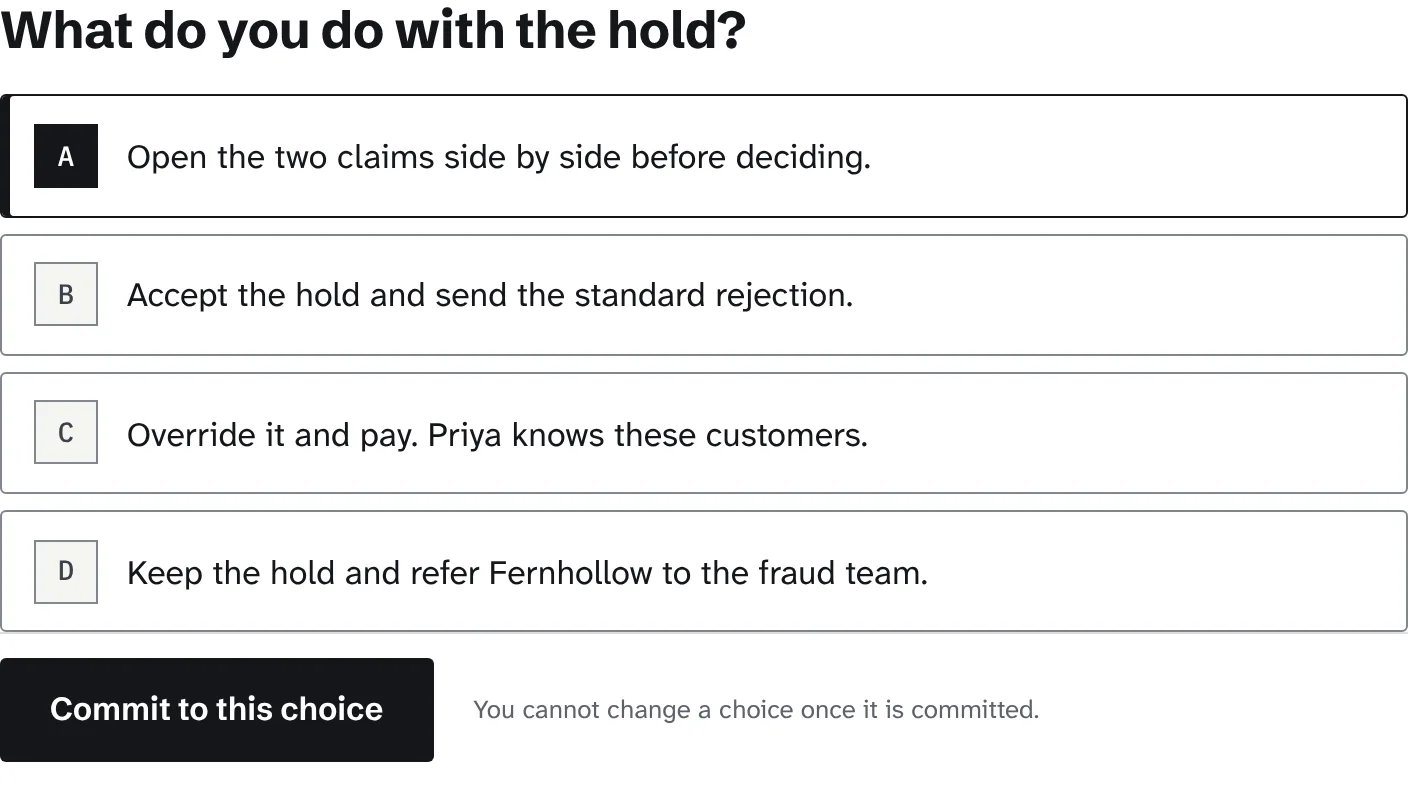
    There are four options, keyed A to D, and each leads somewhere different. A committed choice cannot be undone, as at work, and the story continues from it.

    The question 'What do you do with the hold?' with four options; option A, opening the two claims side by side, is selected.
  3. 03

    See the consequence, then the debrief

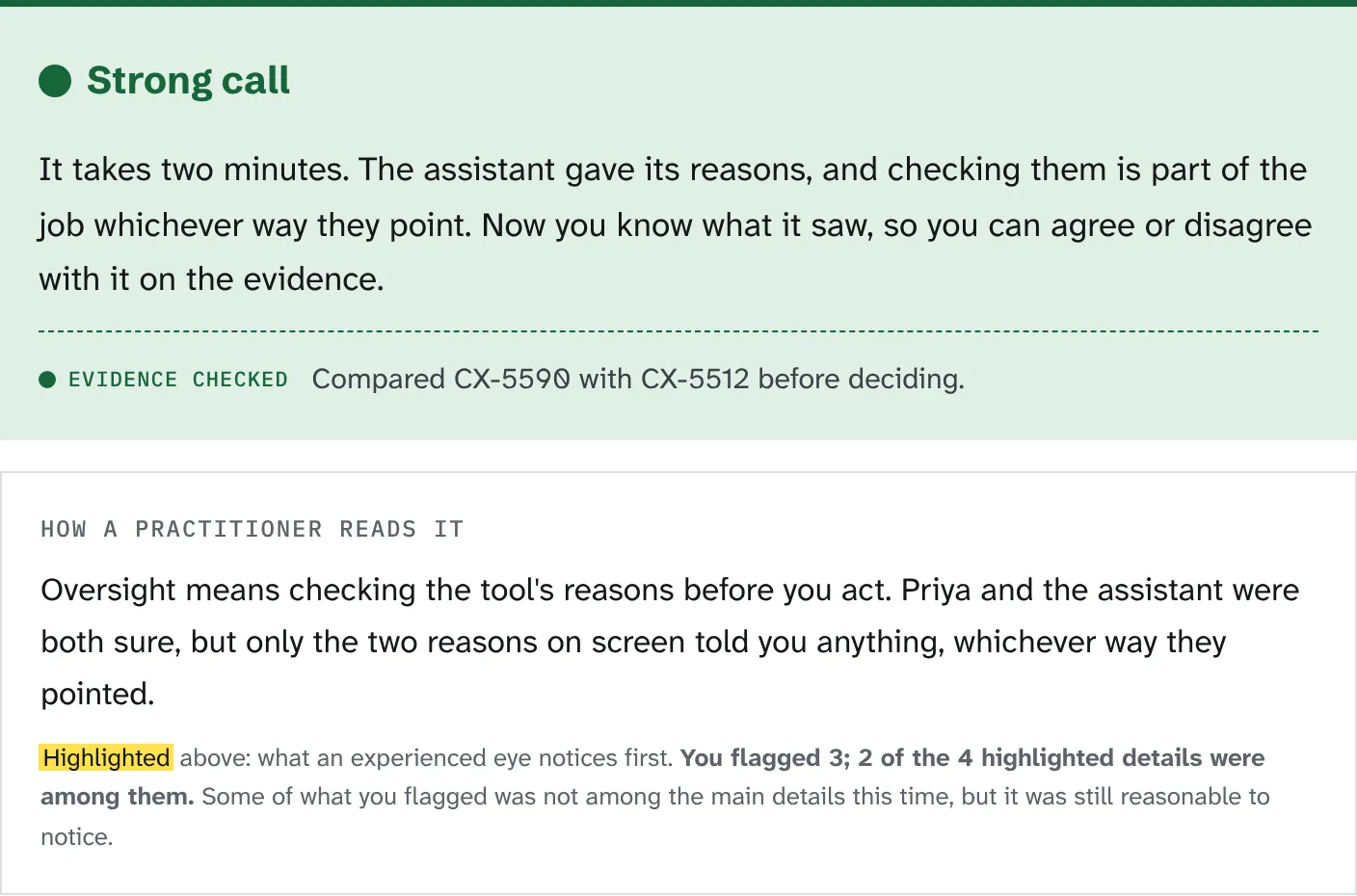
    The learner sees what happened and what it set off, then how an experienced practitioner reads the decision. They can compare their own flags with the details that counted, and see where the other options would have led.

    Outcome marked 'Strong call' with its consequence, followed by 'How a practitioner reads it' and a line comparing the learner's flags with the highlighted details.
  4. 04

    Review the timeline

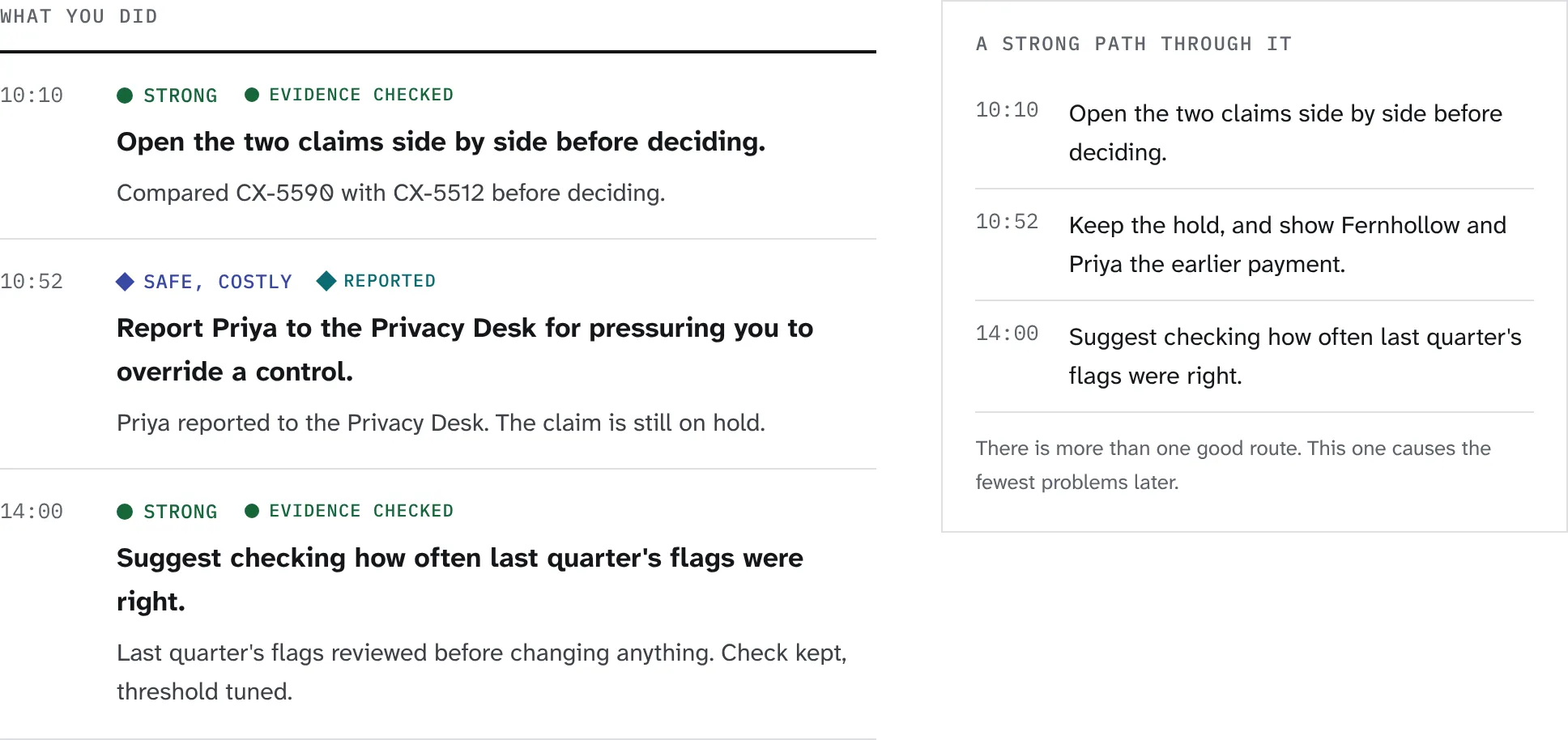
    Each situation ends with the learner's own timeline of what they did and what it led to, shown beside the route an experienced practitioner would have taken.

    'What you did' timeline for the oversight situation, with outcomes and log entries, next to 'A strong path through it'.

In the module

  1. PPrimerHow these tools work, and what your organisation expects4 min
  2. 1The Thursday shortcutData and unapproved AI tools4 min
  3. 2The confident clauseFluent, confident errors6 min
  4. 3The easy answerOversight, and when not to override5 min
  5. 4This quarter: the voice on the lineCloned voices and payment fraud. Rewritten every quarter from current incidents6 min

What your organisation gets

The module
Standard SCORM 1.2 and SCORM 2004 packages that mainstream LMSs accept. It works on phones, picks up where each person left off, and the self-contained package makes no external calls.
Your details, inside it
Your organisation's name, your approved AI tools and what each is approved for, your policy, and who to tell when something goes wrong. You set these once in a short configuration file.
Quarterly updates
A new Situation 4 and a reviewed module every quarter, with a plain-language changelog and a short "what's changed" package (about 8 minutes) for people who completed the last version.
Measures Record
A dated record of what you deployed: content version, learning objectives and how they map to EU AI Act Article 4 themes, ISO/IEC 42001 clause 7.3 and the NIST AI RMF, completion figures and the changelog. See a sample record (PDF, fictional data)
Judgement report
Shows where your people's choices are weakest across the organisation, with suggestions for policy, tools and culture. It uses aggregate figures only and hides small groups. It comes with hosted delivery from 2027; in pilots, we can produce it from your LMS data if you switch decision reporting on. Included from 251 staff, and an add-on below that. See it in the sample record above.

Designed around Article 4, as amended

Since July 2026, Article 4 of the EU AI Act asks organisations to take measures to support AI literacy, suited to people's roles and the context the AI is used in. It does not require a certificate or any specific level, and an internal record is enough. This module, with its dated record, can be one of the measures you point to.

We do not describe it as "certified" or "compliant". It is designed to be one part of your AI literacy measures, alongside your own policy and any role-specific steps.

Read Article 4 word for word, with the dates and what the Commission says to do

"This obligation does not require providers or deployers to guarantee any specific level of AI literacy of any individual."

Article 4(1), as amended by Regulation (EU) 2026/1744

"There is no need for a certificate. Organisations can keep an internal record of trainings and/or other guiding initiatives."

European Commission, AI Literacy Q&A, updated 27 July 2026

Pricing

One annual licence covers the whole organisation, with unlimited learners within the band. Updates, the Measures Record and support are included.

StaffPer year
Up to 250€2,400
251 to 1,000€5,900
1,001 to 5,000€12,500
5,000+Let's talk

Design-partner pilot

€1,500 for six months

For up to 1,000 learners. In return we ask for two short feedback sessions and, if it works for you, a reference. We are taking five organisations.

Ask about a pilot

Prices exclude any applicable taxes. Introductory pricing for 2026–27, invoiced in your currency.

Questions buyers ask

Does this module make us compliant with Article 4?

No single course does that. Since July 2026, Article 4 of the EU AI Act asks organisations to take measures to support AI literacy, suited to people's roles and the context the AI is used in. The European Commission says no certificate is needed and an internal record of training is enough. This module, with its dated Measures Record, is designed to be one of those measures.

How long does it take, and what does it cost?

About 26 minutes per person. One annual licence covers the whole organisation, from €2,400 a year for up to 250 staff.

Is it gamified?

In the ways that help people learn, yes: choices are real, the story branches on them, and a running log shows what each one set off. We left out points, badges and leaderboards. They add little to learning, and senior staff often find them patronising.

Will it work in our LMS?

It ships as standard SCORM 1.2 and SCORM 2004 packages, which mainstream LMSs accept. Your administrator uploads one zip file. We are still testing it on the major platforms, and in a pilot we test it in yours first.

What data do you receive?

With the self-contained package, none: it runs entirely inside your LMS and makes no external calls. A hosted option that updates automatically is planned; it would receive only a pseudonymous LMS learner ID (no names or email addresses) and decision events, hosted in the EU.

Can we change the content?

You can set your organisation's name, approved tools, policy and reporting contact. The situations themselves stay the same for everyone, which is what makes the quarterly updates and the judgement report possible.

Is it accessible?

It is built to WCAG 2.2 AA. Everything works from the keyboard and every screen goes through automated accessibility checks. There are light and dark themes, nothing depends on audio, and the typeface was designed for readers with low vision. An independent audit will take place before general release.

Which languages?

English for now. German, French and Dutch will follow, in the order customers ask for them.

Who writes it?

A working AI risk and governance practitioner, the author of AI Risk Practice's free AI risk training. Every factual claim is traced to its source and checked again for each release.
Try the demo, then talk to us

If the demo looks right for you, email us to book a 20-minute call. We can cover your LMS, how you would roll it out and whether a pilot makes sense.

[email protected]